Sunday, 24 July 2011

Islands in the Stream

After a dateline crossing mix up and some delays, Luke and I arrived into Aukland airport, dazed, confused -and I imagine looking a little worse for wear. We were delighted to arrive at the luxury and comfort provided at the house of the lovely Jen.

Arriving in New Zealand instantly resulted in a feeling of confusion. Having spent the last seven months travelling round distant and foreign lands, it was quite crazy to arrive in the most distant of all lands -in fact, the furtherest I've ever been from home - and feel like you are back into familiarity. Brand names like home; speaking English like home; TV shows like home; cars stopping at pedestrian crossings like home... and yet it's not home! This confusion resulted in me speaking in Spanish to a baffled imigration officer and Luke baffling car drivers with his strange pedestrian ways.

After 12 hours on a plane that appeared to be held together in places by black tape and string (after 7 hours in Buenos Aires airport waiting for the delayed said-plane and 22 hours on a bus from Patagonia) we were hoping for a pretty laid back and relaing time in Aukland. And in what better city to relax than this laid back metropolis? Aucklanders (and quite fankly Kiwis in general) are happy, friendly and so laid back they are barely standing. Walking through the financial district and high street in the city centre, I - being from London - expected to find people dashing around in suits, looking serious and slightly agitated, with a look that imediately reads "get out of my way, I'm rushing to do something very important."  Instead you find people in shorts and flip flops, dawdling along without a care in the world.

Auckland isn't packed with touristy things to do, but is lovely to wander around. Drenched in sunshine and surrounded by sea it's an incredibly scenic city, complete with two harbours. Sitting as it does inside a ring of volcanoes it is also surrounded by majestic volcanic hills and islands.

A great introduction to New Zealand and all things Kiwi is the Auckland Museum. The highly aclaimed display on Maori artifacts and culture are brilliant, and give a newcomer to New Zealand a good overview of Maori life. There are also some really informative history sections covering New Zealand's history -both white and Maori. Unusual for me to say, but more fascinating still is the natural history sections which explains how and why New Zealand has such unique wildlife, and illustartes evocatively New Zealand's earthquakes and volcanoes. The museum itself is in a beautiful park and the walk from there to the skyscrapers is enjoyable.

Auckland is New Zealand's biggest and most vibrant and mutlicultural city. Ok its not New York or London or even Mebourne, but then it doesn't pretend to be. It's a great place for eating and drinking -I imagine it would be even better if you weren't on a tight backpacker budget. Due to its proximity to Asia it does have a prolifertion of good and cheap Thai, Vietnamese, Malayasian and other Asian food. Aukland, like the rest of New Zealand, also has great coffee and an array of great coffee shops. We stayed in Ponsonby which has a mouth-watering array of of cafes, bakeries and restaurants as well as a selection of beautiful, typically New Zealand, wooden houses.

The best thing about Auckland is its position as a vibrant city in touching distance of countryside, beaches and beautiful islands. Its good for the city lovers and outdoorsy types in one.

A must do in Auckland is to take a ferry either over to Davenport or to one of the many surrounding islands. Thanks to our lovely Kiwi host Jen we had a great day out on one of the less touristy and clearly underated islands (Tiritiri Matangi Island) with Jen, Richard and Nathan. Not only was Nathan lovely, he had a fantastic knowledge of native birds and a good eye for potting them -something Luke knew little to nothing about.

New Zealand has no native mammals and before the arrival of humans was a land of birds. It really was like the land that time forgot, with a variety of unique birds -many of which were  flightless -the largest of which was the giant moas which were three and a half metres tall. Sadly, like other native birds moas are now extinct, due to hunting, destruction of habitats and the introduction of unnatural predators, like dogs, rats and possums to New Zealands. Many more of New Zealand's birds have become endangered for the same reasons including the famous kiwis. Being two remote islands, New Zealand has a very delicate and unique eco system which can be easily damaged by the introduction, not only of predators but even ants, fruit or soil -New Zealand has a constant battle to protect its natural habitats and its farming industry -hence its strict custom and excise on the importing of foods or soil.

Tiritiri Matangi island is a protected reserve which has only native trees and birds -no dogs, rats or even ants are allowed to travel to the island and visitors are asked to ensure their shoes and clothing is clean. As a result this tiny island has birds  and wildlife you don't see anywhere else.

We had a great day on the island, enjoyed a picnic down on the beach, and topped the day off with a kiwi beer (as in a beer made in New Zealand -not with the fruit or the bird) on the quays looking out at the harbour. Could it get any better? How about a great Thai meal, New Zealand wine and fabulous Italian ice cream and tea back and Nathan and Deborah's.

A big thank you to Jen, Nathan, Deborah and Richard for a perfect Aukland day!

And what these four all have in common with other Kiwis we met later on our journey is their enthusiasim for New Zealand and all it has to offer. The really love their country and were bubbling with good ideas for a great road trip.

So having introduced us to the food, flora and fauna of New Zealand, as well as the very lovely Kiwi film Boy, Jen took us to pick up our spaceship campervan -a converted people carrier, loaded up with a DVD player, a fridge, cooking facilities and a very comfy bed.

And from there we headed North...


Until next time, stay warm!

Luke and Louise

Posted by Louise

Wednesday, 13 July 2011

Every day when I wake up, I thank the Lord I'm Welsh

"You’ve got to go to Patagonia when you’re away. It’s full of Welsh speakers, just like a little Wales.” (Spoken by a London-based work colleague who had self-evidently never visited either place.)


Long before we set out on our travels, the lion’s share of which we’d planned to spend in South America, Patagonia had already begun to annoy the shit out of me. We were heading to a continent unlike any other, fit to burst with complex and varied histories, cultures and peoples. We planned to visit emerging democracies and glorified dictatorships, view unparalleled natural wonders – and some unspeakable ecological travesties. Our trip was also to be a culinary adventure, from the thick soups of Ecuador, via the one-pot wonders of Bolivia, to the meat-eaters’ Mecca that is Argentina.

So why were so many of our family, friends and casual acquaintances so fixated on our travelling half way around the world to eat Welsh Cakes and hang out with some people who were… er… a bit Welsh? More to the point, why the hell would I want to? I’d already spent enough time doing just that as a kid – it was called going to my Nan’s. It seemed to me the very worst sort of safe, narrow and ultimately pointless travel; seek out the familiar, squint your eyes a little and wish really hard, and you could almost be back home. Worse still, the whole concept of Welsh Patagonia, so savage and beguiling in itself, had to me become all too often a lazy reference point for those looking for a knowing, slightly-exotic-Welsh badge to stick on their book, restaurant or (most horrifically) film.

Of course, as is so often the case when travelling, the reality of the place turned out to be a million miles away from the Wikipedia-based recommendations we’d received. The Patagonia that Lou and I visited was an indisputable highlight of our time in South America, but for precisely none of the reasons that had been urged upon us back home.


But history class first, with a disclaimer that this is a travel blog and not a University thesis. Dates may be a bit out, orders a bit skewif. If you want comprehensive accuracy (and some pretty fine turns of phrase), look here. Anyhow, for anyone who doesn't know the story, back in 1886 Welsh settlers on the ship Mimosa arrived in what is now Puerto Madryn (named after Love Jones-Parry Baron of Madryn) with the dream of setting up a new Welsh speaking colony – again, a handy history here. The Argentine government encouraged immigration of Europeans to settle outside Buenos Aires, as this chimed with their wish to expand the country.

The Welsh settlements of today are a few towns in the Chubut region which now have a distinctly Argentinean flavour, and of course the official language is Spanish. However, the town and street names remain as Welsh as they come, along with indisputable dashes of Welsh culture, some preserved in aspic, some with a keener eye to the future. Indeed, following the centenary celebrations of the first Welsh settlements in 1965, there has been a revival of the language with as many as 1500 people now speaking Welsh in the area today, thanks in large part to some savvy investment by the Welsh Government. The annual Eisteddfod, a major event in the locality and widely participated in, is also a unique testament to the area’s Welsh heritage.

Outside of Wales, however, Patagonia is not synonymous with all things Welsh. Covering 1,043,076 km2 square kilometres of land and traversing the Argentina and Chile, the main reason so many people from across the world make the journey to this remote part of the world is for the magical array of wildlife and walks afforded by Patagonia’s vast, apparently desolate but most definitely enchanting steppe.

And so it came to pass that our Patagonian adventure was spent entirely in this Welsh region, ostensibly because of Lou’s love of penguins. I can also admit, though, that after seven months of travelling the world I was a more than a little drawn by the thought of this little bit of home away from home, a far and distant land so often talked about. Was I guilty of the travelling laziness that had so infuriated me back home, six months and a thousand years earlier? Possibly. Regardless, I could at least visit with the handy excuse that the nifty town of Puerto Madryn also makes an ideal base for exploring the area, and is only a 22 hour bus journey from Buenos Aires.

Though there are longer, more arduous and possibly even more rewarding ways to experience the landscape and its inhabitants, you’d be hard pushed to better a day driving around the Punta Tombo reserve for sheer bang for your Pesos. Only a couple of hours drive from Puerto Madryn, the reserve is one of the best marriages of sustainability and accessibility that we’ve experienced on our travels so far. Walking through the gates is like stepping into ‘Happy Feet’ – surrounded by penguins, all going about their business and oblivious to their uninvited guests. With their habitat largely untouched save for some sympathetically installed wooden walkways and bridges, the whole experience can be a little overwhelming, especially for those who’ve only witnessed these fabulous creatures in a Zoo before. It also makes other more hands-off ventures – like Phillip Island near Melbourne – seem overpriced and oversold by comparison.

Equally enchanting, though far grander in scope and scale, is the Peninsula de Valdes. A veritable cornucopia of fauna and – less obviously to the untrained eye – flora, it’s almost impossible to remember that you are in a reserve as you trundle along dusty dirt tracks. Armadillos, elephant seals, sea lions and yet more penguins abound, along with stretches of deserted beaches and rugged cliff-faces just waiting for to be lashed by frothing waves.

But what of the Welsh? Despite my earlier misgivings, it would have been wilfully contrary (even by my standards) to be in town and not scratch beneath the surface. And to tease out the most rewarding parts of today’s Welsh culture in Patagonia, you need to scratch a fair bit. Aside from the aforementioned street names, Puerto Madryn really doesn't retain much of its Welsh heritage, happy in its current well-established role as a visitor hub and port. To get a real feel for the Welsh heritage in region, we bundled into our entirely unsuitable three door and headed for the towns of Trelew and Gaiman.

In many ways, Trelew felt to me like the most ‘Welsh’ of any place we visited in Patagonia – it was certainly the place that reminded me most of home. Though destined to disappoint visitors looking for the green, green grass of home, its brutal industrialised appearance bore a remarkable resemblance to parts of the Valleys before the post-Thatcher regeneration schemes had made the slightest impression. Indeed, looking out over Trelew on the bypass road is strikingly similar to the Heads of the Valleys, complete with sculptures that are as vast as they are ugly, and gardens of garbage that seem as old as the verges they sit upon.


For the traditional Welsh money shot, however, Gaiman is the final destination. We arrived in the middle of a sandstorm, but managed to follow the bilingual signs to our first port of call, the Welsh museum. Once inside, I was immediately transported back to a childhood of day trips with my immeasurably knowledgeable – and with the benefit of hindsight hugely Welsh Nationalist – Godfather, Terry. It was Terry who started a lifetime’s fascination with steam trains and associated adventures by rail, which often took in many of the parts of Wales that he lived, worked or holidayed in throughout his life. (It was probably also Terry that helped invest me with an occasionally foul temper that still causes me problems today). But here I was on the Argentinean steppe in a small building so wonderfully, yet so intangibly, Welsh that I welled up with tears. I could hear Terry’s voice tell tale of the Gwalia Stores in the Ogmore Valley, see his rain-splashed face on the beach in Aberystwyth, smell the musty odour that the self-published volumes of Welsh history would carry whenever he showed me an article that he liked or had written.

The brown-spined books, faded photographs, Welsh dressers and chairs and… out of nothing, a gentle questioning in a language I recognised but could not understand from behind me. I turned to find a hunched, shawl-wearing woman of at least 80 years of age speaking to me in a lilting, mellifluous Welsh. Unable to reply in kind, I tried English, but to no avail. We (almost entirely through Louise) eventually settled on Spanish, her other language, to establish that she was born and brought up in Gaiman, but was a proud Welsh woman and worked at the museum every day it was open. I was Welsh, I explained, from Cardiff. But we’d already lost her a little, a smile that struggled for acknowledgement turning instead to vague confusion. But her blue eyes, doubtless once piercing, were milky with age but still retained an enchanted sparkle. And I struggled to turn away.

But every silver lining has a cloud, and we encountered ours as made our way to the door. A heavily perfumed clotheshorse stopped us as we were leaving, asking where we were from. She spoke no Spanish, despite living in Argentina, opting for the “get in the locals face and talk loudly in English” approach so beloved of ignorant Brits the world over. After I explained that we were from Cardiff (Louise now being an honorary Welshie in most circumstances), she told us she was from Penarth and asked if we could speak Welsh. When I explained that we couldn’t, she remarked – in deadly seriousness – “Oh. So you’re not proper Welsh like me, then.” No I’m not, I thought. I’m from Splott – and a whole lot better than that.

But it was our time in one of the many Welsh Tea Rooms that things became properly bizarre. Gaiman has a multitude of Tea Rooms, all professing to offer a traditional Welsh tea and give the visitor a real Welsh experience. Well Louise and I certainly enjoyed the experience, but Welshness – like beauty – seems so often nowadays to be in the eye of the beholder.


And I am certain that the large Union Jack that greeted us at the Princess Diana Welsh Tea Room wouldn’t have gone down that well with everyone back home – though the even larger Welsh flag draped over the doorway did look damned fine in the Argentinean dusk. We filed past Welsh dressers filled with lovingly presented trinkets of the Royal Family, and ate plates after plate of cakes, scones and sandwiches. The Dulce de Leche pastries certainly didn’t remind me of home, but the pot of tea – knitted cosy and all – was the first decent brew I’d had since leaving Cardiff, and reminiscent of the dark brown elixir that I remember my Bop (granddad) drinking from the moment he woke up to the time he went to bed. And I was thinking about this weird cultural mish-mash while availing myself to the (very frilly) toilet facilities in the Tea Rooms when I found myself humming along to the piped music. And what were they playing? Why, Jerusalem, of course. As an unashamed and proud Welsh Brit, I found the whole shebang pretty damned amusing, though I can imagine that our friend from Penarth would have baulked at what she would have no doubt viewed as a lack of cultural purity.


So did Lou and I find the Welsh-speaking Mecca that our London friend had urged us to visit? Was it like a little slice of Carmarthenshire on the other aside of the world? No, of course not. Equally, it was so much more than I’d hoped for or expected, and an experience that will stay with me forever. I can only hope that the money that the Welsh Government spends on language and cultural programmes in this part of the world - relative chicken feed in the grand scale of things – survives any follow-on cuts as a result of the UK Governments slash and burn economic approach. In terms of 'bang for your bucks', it's delivering on the ground in a big way, even if the ground in question seems like a long way from Cardiff Bay. Former Culture Minister Alun Ffred-Jones wisely extended the scheme until the end of 2012, and I’d certainly advocate extending it again, if only to keep those milky blue eyes that so captivated us in the museum in Gaiman sparking for a few years yet.

Stay warm,
 
Luke and Louise
 
(Posted by Luke)
 

Thursday, 30 June 2011

And it looks like we might of made it to the end...

So for anyone who was wondering if we would ever finish with Buenos Aires, here are our final Buenos Aires highlights... and on to the next part of our journey. 


Palermo
Palermo is a large 'barrio' north west of the centre, and is split in two by the central road Avenue Santa Fe. The mainly residential northern part is filled with parks and posh houses, and as the greenest part of BA is beautiful on a sunny day. Palermo Viejo, its older neighbour, is the trendiest part of town, and is choca block with fancy boutiques, funky craft markets and a vast array of bars. Its the perfect place to spend a sun soaked day wandering aimlessly round shops even if you don't plan on buying anything. It's also a great to sit outside drinking ice cold beer at one of the many bars watching those much trendier than yourself shopping to their hearts content. It also the place where Luke and I spent a month living in an apartment, and it was certainly our favourite part of town.

Whilst Palermo isn't filled to the brim with tourist atractions we managed to fill the majority of our time in BA just hanging out in this part of town. The parks, especially the Japanese Gardens, are stunning and great for people watching in the summer. Luke, Frances and I also had a fun day out at the zoo. As well as the array of clothes and music shops which kept us amused for hours Palermo is also bursting with restaurants, cafes, posh empanada shops and ice cream shops -stocking enough flavours for a different flavour every day for a month. The number of delis was christmas present enough for Luke.

Both on our own and with all four of our different guests we had many a good night in and around Serano Square. From New Year fireworks let off in the middle of the street by random people to a mute magician who wowed us with his awesome tricks to sunny Sunday afternoons with a beer.

Museums and Galleries
Buenos Aires is a culture vulture's dream, teaming as it is with a varied and sometimes weird, collection of museums and galleries, catering to all interests. We didn't go to any where near all of them, or even all of the good ones in the month we were there, but then that is th real joy of choice. If your not into pots and textiles there is an array of other wierd and wonderful places to choose from.
Personal highlights include the Evita Museum was a great museum detailing the history of one of Argentina's famous icon. Eva Peron divides opinion as to whether she was a national hero or tyranical villian -though its fair to say the Museo Evita make it clear they view her as a hero. Either way she's a facinating character. One of Argentinians most famous galleries Museo Nacional de Bellas Artes in Recoleta had an interesting if sometimes bizzare collection of Argentinian and European art. I prefered the MALBA (Buenos Aires Museum of Latin America Art), a relatively new modern art gallery (free on Wednesdays). When David and I visited amongst other things they had a Marta Minujin display-Argentina's answer to Warhol and a room made of beds that you could get into.

Recoleta
Recoleta is the original wealthy neighbourhood of Buenos Aires. Following the cholera outbreak in San Telmo all the wealthy families moved up the hill north of the city to escape the disease, leaving San Telmo to those who couldn't afford to leave. Recoleta was the place they moved to, and it is to this day still a swanky surburb. Recoleta is full of beautiful houses, shops and restaurants, a particular highlight being the cinema turned into a bookshop.
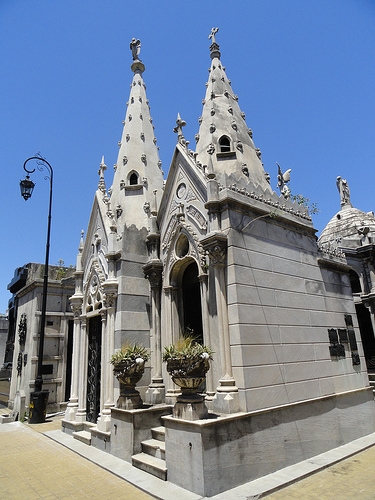
Recoleta, however is most famed for its cemetary. It may seem strange to refer to a cemetary as a highlight, but anyone whose been to Paris will know how spectacular a cemetary can be, and Recoleta is BA's answer to Perlachese. Argentines glorify their dead, and its fair to say there's more to this cemetary than a few gravestones. The burial place of the rich and famous is far more decadent, with each family tomb competing to out do the next. You can wander for hours through the crumbling statues and maginificent stain glass of mausoleums. You can of course search out the graves of several famous Argentines. The most famous being Evita's grave.

Luke, David and I certainly spent a good few hours here, before heading into Recoleta for an amzing ice cream.

Porteňos

From some mad performances on the underground to the lovely waiters in el penguino Beunos Aires is filled with interesting and kind people, who lack the snottiness we were forewarned about that this city is so famed for. That said being from London, everywhere I go I find people friendy.
Being tourists you often an inevitably end up hanging out in places where there are other tourists (especially if you don't speak good Spanish), like hostels and tourist spots. So for a change we took Chris along to a night of Spanglish -a speed dating style night where English speakers and locals rotate round the room practicing speaking in Spanish for 10 minutes and English for 10 minutes. Chris having not ever spoken Spanish before was very nervous, but surprised himself by having a great night learning Spanish and talking to an array of local people, brimming with enthusiasm for their city.


And so it looks like we've finally made it to the end of our Buenos Aires blog and I didn't even get chance to tell you about the day trip to the countryside, our day out in Uraguay or the sunny River Delta - it's a city with just too many highlights. You'll just have to see the photos.

After a truly wonderful fun packed month in this seductive capital we set of for Patagonia.

Until next time stay warm,

Luke and Louise

Posted by Louise

Tuesday, 7 June 2011

To flesh-coloured Christs that glow in the dark...

Buenos Aires Highlights Part II

Having neglected to write a blog for over a month we have returned with an updated and new look blog, and with the long awaited continuation of some Buenos Aires highlights we started long ago!

So here it is. For anyone whose been on the edge of their seat unable awaiting part II, apologies for the delay and I hope the wait was worth it!

Ok if you've only got a few days in Buenos Aires then maybe a religious theme park wouldn't be on your list of things to see.  But not only is Santa Tierra the only religious theme park in the world, but it hosts the world's largest (and I suspect only) all year round animatronic nativity scene.

And if thats not enough for you it also hosts an emotive, life size antimatronic reconstruction of the Last Supper, a kitsch (if not very life like) electronic recreation of the Creation and - to top it all an - 18 metre high Jesus who is ressurected every hour, on the hour.

I should at this point clarify that Tierra Santa doesn't have rides - it's a park with a theme, more than a theme park  - but it is however a fun and educational day out for all the family.  And a bargin at just over a fiver (Nuns and Monks take note - you get a discount if you belong to a religious order).

The whole park is a plastic Disney World style reconstruction of Jerusalem around 30AD. All the staff are dressed as Roman soliders or put upon Israelites, there are tasteful Arabian dancing shows and you can enjoy a beer and a kofta in the Road to Damascus Cafe.

Throughout the park there are life size statues of Jesus at different points in his life, from the time he turned water into wine or Palm Sunday he was greeted by crowds riding into town on a donkey. You can even get in on the action and get a photo.

Quite bizarrely, perhaps as a step towards inclusiveness or for educational purposes, there are some other relgious big hitters in plastic form as well, including Martin Luther and Ghandi. And of course, no Jerusalem would be complete without a Synagogue or a Wailing Wall, though I did wonder if the Mosque was a bit before its time. All down one side of the park you can see the Stations of the Cross, culminating outside Jeruselem in the true to life (if plastic) Cruxification on the hill... with the Argentine flag blowing in the background.

I think it's fair to say that if you've been to Disneyland - or even on the Bubble Works at Thorpe Park - you may find the animatronics a little limited, especially the Nativity. That said, if you're an Argentinian Nun then your unlikely to have visited either, in which case you'll find the Creation recreation pretty magical. The nuns sat behind us certainly did.

And yes - there really were real life Nuns there. Lots of them. Ironic as it may seem ,this park is not a joke - Monks, Nuns, Priests and families alike take the whole day very seriously. There were people moved by the Last Supper, gasping at the appearance of a gorrilla with a moving finger during the Creation and stood in awe and amazement at the Resurection, although that could be because the resurection was cancelled twice the day we were there due to a technical fault.

Kitsch and crass as the whole thing may appear on the surface, and far from the Bible's teachings as it may seem to many, it's easy to see the whole park has been put together with well intended love and devotion. It also achieves some quite frankly harmless Jesus related fun.

Luke, our friend Jo and I planned to spend an hour or so at the theme park, but six hours and a bottle of wine later, we finished off our perfect day with a photo with a giant Jesus and view from the Cruxification hill out of Jerusalem at night.

Tacky, inappropriate... or just what Jesus would've wanted? I'll let you decide. What I can tell you is that its a fun, if not rather bizzare, day out.

Stay warm, until next time.

Louise and Luke

(Posted by Louise)

Saturday, 2 April 2011

Stop me if you think that you've heard this one before - Buenos Aires highlights (Part One)

As many readers will know, Lou and I left the joys of South America, and with it Buenos Aires, behind about eight weeks ago. But the challenges of living in a van in New Zealand, then trying to find jobs and somewhere to live in Australia, means that we're still very much there in blog-land. In a desperate attempt to claw ourselves back up to date, here's the first half of our Buenos Aires Top Ten. Apologies if some of it seems familiar due to Facebook, Flickr or Chris Binding. On a personal note, sitting in a slightly dingy hostel in Melbourne waiting to see if someone will relent and let me work in data entry for a few months, it's quite a joy to cast my mind back to the days when the wine wasn't shite, a block of cheese didn't cost a year's wages and the locals actually seemed to like me...

La Casa Rosada (The Pink House); Plaza de Mayo

If you only had one day in Buenos Aires you'd probably start in the centre of the city at Plaza May, home to the Cabildo (the original home of government under Spanish rule), the Cathedral and the impressively pink, Presidential home La Casa Rosada or Pink House. This square marks the spot where the Spanish conquistadors first landed, which seems a little odd as today it's now over a kilometre from the water. As South American squares go it is not the most glamorous but is still pleasant enough on a sunny afternoon.

As we were wondering across the Plaza on one such afternoon, trying to avoid the protesters demanding better rights for Falklands veterans, we happened to notice some passers by who seemed to be walking in to the Casa Rosada, which is usually pretty much off-limits to visitors. As luck would have it,thanks to Argentina's centenary celebrations and Cristina's open house policy, the whole shebang was open to visitors on an almost unfettered basis.

As political junkies, we found this to be both amazingly exciting and amazingly... well... amazing. As Lou put it, our entry was akin to passing by Downing Street and being asked in for a nose about by one of the coppers  in the guard house. As two veterans of events at No 10 (back in the days when we were on better terms with the occupants), what made our stroll around the Casa Rosada all the more amazing was the fact that, barring a few amusingly be-hatted soldiers, we could go pretty much where we liked.


And so it was that we sat down in the Cabinet Room, took snaps in the private meeting quarters of President Cristina Fernandez de Kirchner (which we'd seen on telly only the day before) and mosied through the courtyard garden. Perhaps most excitingly, though, was the chance to stand on the famous 'Evita' balcony from which both Eva and Juan Peron would address tens of thousands of adoring Portenos in scenes that often reached almost religio-orgasmic levels of passion. Pretty damned cool, all in all.


La Boca

This traditionally working class neighbourhood is probably Buenos Aires most famous, known for its tango, its football and its brightly coloured building. Indeed, all the symbols and stereotypes of Buenos Aires are here in abundance. It's also got a rep, not helped by the near-hysterical online tips and guidebook warnings, of being really rather dangerous. Some parts may well be, but the advice to go on organised tours or catch a cab in and out is patently absurd. Stick to the central tourist zone, and the worst that will happen is getting fleeced by a street hawker.

Being right on the mouth of the river (hence the name), La Boca was home to the hundreds of Italian, Spanish and other immigrants who arrived to work in the docks in the 19th Century. So the story goes, these immigrants couldn't afford the paint to maintain the overcrowded corrugated iron buildings in which they lived and so stole left over pots of paint from the ship yards, resulting in the brightly coloured patchwork effect that remains today in El Caminito.

Unsurprisingly, the Caminito is now incredibly touristy, packed with tangoers, restaurant sharks and a fake Maradona for you to pose with (watch out for him as he charges, as I found out to my cost), and array of stalls to buy a selection of Boca Juniors and tango memorabilia. That said these famous streets still hold a colourful charm of their own.

Unfortunately, as it was January, we didn't get to go to a Boca Juniors game or visit the cutting-edge Proa Art gallery, but I understand these are real La Boca highlights. That said, the bus journey from Palermo to El Caminito is a highlight in itself, taking you on a journey through all the city centre highlights for the princely sum of 15p.

Exploring the shops

As backpackers, finding yourself in something of an alt-shopping Mecca is an obvious mixed blessing. Fab boutique canvasses to hang in the house you don't own, wonderful handmade knick-knacks for the kitchen in the house you don't own, books about books about books none of which will ever fit in your already absurdly sized rucksack – you get the picture. It's a testament to the sheer fabulousness of the shopping in BA that these considerations hardly flit into your head, as you browse liked an automon on methadone through rack after rack of the trendiest threads this side of Hoxton, all five times as cool and less than half the price as anywhere back home.

Both San Telmo and Palermo have much to offer in the retail stakes (see below), but there are shopping fun and games to be had across the whole city. From the bonkers 'pound' shops that line busy high streets to the mega-malls that can hold their own in size and glamour with the best that Paris, New York or London has to offer, and pretty much everything else in between. But my abiding memory of BA retail therapy is the abundance of superb, independent bookshops, record shops and wallet-threatening hybrids thereof. Though not the finest in stock terms, you can't visit and not drop by the magisterial El Ateneo book store. Housed in the former Grand Splendide Theatre, you get to browse happily in any number of comfy cubby holes, former theatre stalls and balconies while pant-wettingly opulent chandeliers hang overhead. If the shelves hadn't been lined with mostly Spanish-language books, I'd still be there now.

San Telmo

A neighbourhood sitting on the knife-edge of a faded but glorious past and a gentrified future with all the wankiness that brings, San Telmo was the place that best represented the Buenos Aires I'd read and dreamed about before we arrived. As the stunning, though usually crumbling, colonial buildings suggest, San Telmo was once a barrio to be reckoned with. Moneyed families, merchants and minor aristocracy called it home, only fleeing for the hills when yellow fever came to visit in the early 1870s. While they left behind the glorious architectural legacy, the immigrants, poor and dispossessed that crammed into the discarded houses brought tango, an abundance of superb eateries and an undeniable edge of slight danger.

As I've already written about in more detail than is entirely necessary, San Telmo gave us one of our best meals of the trip courtesy of Desnivel. It also, however, threw up an entirely unexpected treat in the shape of Mercado de San Telmo, a delightful covered market selling everything from apples to Spider Man pinball machines and a whole bunch in between. Our San Telmo highlight, however, was the couple of hours we spent with Hosk at the El Zanjon de Granados. A living, breathing testament to the wonders that an amateur archaeologist with a love for his city and a handy personal fortune can achieve, this former mercantile villa and its labyrinthine underground tunnels afford the steady trickle of visitors a unique glimpse into San Telmo's past. Our visit was enhanced immeasurably by our knowledgeable, multi-lingual guide who took the three of us round with a passion and interest often lacking in larger, busier attractions. She was also an Inspector Morse fanatic, which is always nice.

And that's just the tip of the San Telmo experience. You could quite happily eschew all of the above, hit the cobbled streets yourself and make your own discoveries. The only real mistake you can make is to not visit the place at all.

Tango

You can't come to Buenos Aires and not experience tango in some way, shape or form. BA is certainly Tango's spiritual home if possibly not its birthplace, and as you would expect from such a cosmopolitan melting pot, BA Tango comes in all shapes and sizes. Street tango, tourist tango, queer tango, trad tango, solo tango – you name it, they do it.

If you want a hit of free, on the streets Tango, La Boca's main tourist drag is the place to go. Working for a pittance outside the plethora of cafés and restaurants that line the streets, most of the performers are young and looking for their big break or those with a bright future already behind them. Still, as long as you can brush off the menu-wielding hawkers, it does the job.

Catching a show on the street is also handy as the idea of paying to watch Tango is a fairly new phenomena, and one squarely aimed at tourists to lazy / scared / fat to join in. Many of the shows are a world – and several hundred dollars – away from the milongas and Tango halls of old Buenos Aires, and as such, rather shite. There are a few worth a visit, though, including the Confiteria Ideal. For forty Pesos, we got a tremendous, up close and personal show with decent steak and three bottles of wine (Hosk was, of course, suitably punished for taking the veggie option). In the faded downstairs glamour of one of BA's most venerable milongas, the musicians, singers and dancers poured heart and soul into a fantsatic show devoid of pretence but bursting with an almost unsettling sexual energy.

We also took the plunge and hit the Tango floor ourselves with a gay friend we met while travelling, at the suitably if rather obviously named Tango Queer. You might think that the liberated atmosphere would make it easier for the novice, but it wasn't to be. Within minutes, Louise and I were arguing like a married couple (never a good thing in Tango Queer), and the honeymoon almost came to an end in a very real sense. We left just about with our dignity intact, glad to have given it a go, but vowing to never do it again.

Stay warm,

Luke and Louise

(Posted by Luke)

Monday, 14 March 2011

We hate it when our friends become successful - Chris Binding in BA

In a publishing first, here's our first ever 'guest blog', courtesy of Mr Chris Binding. And blow me down with six packets of Skittles Sourze if it's not pretty damned good...


Luke and Louise asked me to write a brief, guest blog (presumably to make their musings look better by comparison).  I’ve never written a blog before but Luke scares me, so here we go.

A last-minute decision to fly the 7,000 miles to Buenos Aires on 3 January (I only booked on 30 December) meant I didn’t really have any preconceptions of what the city would be like.  I did, however, know it was warm and as the UK was experiencing severe snowfall I made the booking and heading for sunnier climes.

Luke had kindly agreed to meet me and the airport and he looked genuinely happy to see me – although I suspect it had something to do with the large jar of Marmite I had brought with me from Blighty.

Despite spending the first day recovering from jetlag we managed to see much of the posh Palermo neighbourhood.  Trendy boutiques, up-market bars and restaurants and ice cream shops (my personal favourite was Dulce de Leche) dotted almost every street.

One of the first things you notice is the lack of money in the country.  There’s a physical lack of cash and each bank is given an allocation each day.  This results in queues of porteños (people from Buenos Aires) outside banks each morning to make sure they have cash for the day.  Once banks run out they have to wait until the next day.  Coins are in even tighter demand (as mentioned in the previous post) and most shops were willing to knock something off the price to avoid giving change – a courtesy we returned by paying a little over to avoid receiving change.

To fly to the other side of the world for a week might seem a little short but I still managed to do a number of firsts, mainly thanks to Louise’s famous organising skills.  An election campaign grid-like timetable was worked up and only the lethargy of Luke and myself knocked us off course.

Horse ridding was absolutely fantastic.  The gaucho (cowboy) showed little interest in health and safety (perhaps he’s a secret admirer of the Tory Lord Young?) and gave no useful tips on controlling the massive equine I was now ridding called Gato (which was unfortunately the Spanish for cat, and not a treat associated with Sara Lee).

A quick-ish stroll around the beautiful surroundings of the ranch and we were back at the stables and the ever-helpful gaucho left us to our own devises to get off the horses.  To make matters worse a small child of no more than 4 then ran over, jumped on the horse and rode it off like a pro.  Clearly a job working the ranches of South America is not my true calling.

Buenos Aires has a fantastic culture of which it is rightly very proud.  Latin America is well known for its dancing and what visit to the city could pass without some dancing?  We opted for a tango lesson (yes, Luke and Louise joined in too.  Well… for the first five minutes).  Whilst language was a barrier, I had no problem understanding the ‘oogh’ and ‘argh’ sounds coming from the poor lady I danced with.  I hope she knew a good chiropodist!

On to possibly the scariest event of the week, Spanglish.  A truly terrifying hour of conversation with porteños who wanted to learn English and English speakers learning Spanish.

Despite their protestations at being ‘learners’ most of the people I talked to had fantastic English which made me feel even worse that I could only speak in Spanish for 30 seconds.  There’s only so many ways I could have a ‘conversation’ by saying my name, where I was from and what I did!  Thankfully most of the people took pity and spent time helping me to count to ten.  It felt like primary school all over again.

The political highlight of the week was being able to visit the Casa Rosada (Pink House) home of the Argentine President and a large collection of memorabilia from Eva Peron.  Casa Rosada has some spectacular artefacts, grand State rooms and picturesque gardens and for any political geek like me, Luke or Louise this truly was a once in a lifetime opportunity – made all the more special as the opening formed part of the country’s celebrations to mark 200 years of independence.
 
Having arrived in Buenos Aires with a shameful lack of knowledge about the city I left with a heavy heart and a strong sense that I’d like to return some day – but will stay for longer than a week.

A brilliant week’s sightseeing and, even better, a catch-up with friends on their adventure around the world.

Chris

(Posted by Chris Binding)